

How to set high standards for mobile repair parts quality
TL;DR:
- Poor-quality replacement parts often lead to failed repairs and customer dissatisfaction, highlighting the importance of genuine, well-documented components.
- Regulatory shifts in the UK and EU now require repair parts to meet standards of compatibility, durability, and transparency, making compliance essential for both professionals and DIYers.
You fit a replacement screen, hand the phone back, and three weeks later the customer returns with a washed-out display and a very unimpressed expression. Sound familiar? Poor-quality replacement parts are one of the most persistent frustrations in mobile repair, and the problem goes deeper than simply buying cheap components. The term “quality” is genuinely ambiguous in this market, covering everything from screen brightness and adhesive grade to legal compliance and manufacturer accountability. With significant UK and EU regulatory changes arriving by 2027, understanding what quality actually means for repair parts has never been more important for professional technicians and serious DIYers alike.
Table of Contents
- How repair parts quality standards are defined
- UK and EU policies: Raising the bar for repair part quality
- What quality standards mean for your repairs
- Sourcing high-quality repair parts: Best practices
- Why “quality” in repair parts is about more than materials or price
- Find compliant, high-quality repair parts with Buy2Fix
- Frequently asked questions
Key Takeaways
| Point | Details |
|---|---|
| New legal standards | UK and EU policies now require long-term part availability, open pricing, and repairability. |
| Defining real quality | Quality now means reliability, supplier transparency, and compliance beyond just materials and cost. |
| Practical sourcing tips | Choose parts with proper documentation, warranties, and compliance verification for safer, longer-lasting repairs. |
| Competitive advantage | Using compliant parts boosts repair reputation and customer trust in a changing market. |
How repair parts quality standards are defined
To untangle these issues, let’s first break down what “quality standards” actually mean for repair parts in 2026.
Quality in repair parts has traditionally been judged on three pillars: compatibility, longevity, and cosmetic finish. Compatibility means the part fits the device and restores full function. Longevity refers to how well it holds up over months of real-world use. Cosmetic finish covers colour accuracy, glass clarity, and texture matching on components like screens, back covers, and buttons.
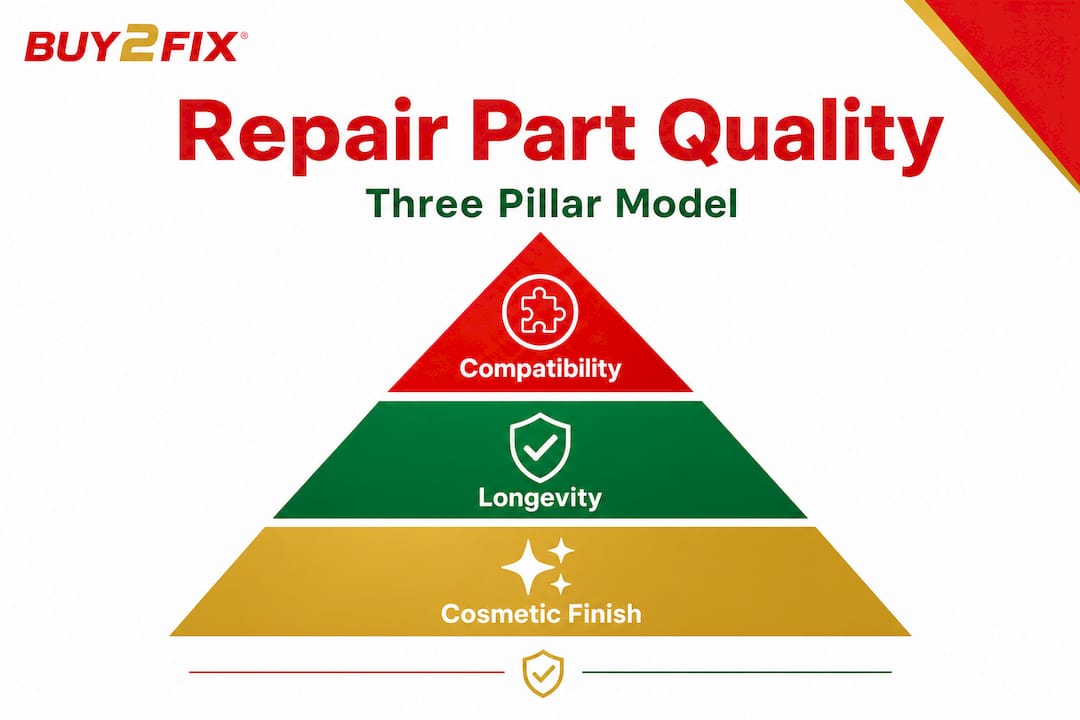
These three pillars still matter enormously. A Samsung Galaxy S22 screen with poor colour calibration is not genuinely compatible, even if it physically fits. A battery that loses 30% capacity within 90 days is a longevity failure, even if it charged correctly on day one. When choosing reliable smartphone parts, these basics remain your starting point.
However, 2026 is pushing the definition further. UK/EU right-to-repair policy is increasingly shaping what “quality standards” mean operationally for parts reliability. The EU’s Right to Repair Directive, which came into force in 2024, introduced the concept of “reasonable time” and “reasonable price” as legal obligations for parts availability. Planned UK rules are expected to require 7-year parts availability from July 2027, which means manufacturers must supply components for at least seven years after a product’s last sale.
Here is how the key quality benchmarks have shifted:
| Quality dimension | Traditional expectation | 2026 regulatory expectation |
|---|---|---|
| Compatibility | Physically fits and restores function | Documented compliance, standardised testing |
| Longevity | Survives normal use | Verifiable durability claims from supplier |
| Cosmetic quality | Looks right visually | Matches manufacturer specifications |
| Availability | Up to supplier discretion | Mandatory minimum supply period |
| Pricing | Market-driven, opaque | Transparent, publicly benchmarked |
| Documentation | Often absent | Required for compliance |
“The right-to-repair movement is not just about access to parts. It is about making the entire repair ecosystem more accountable, from the manufacturer who makes the component to the technician who installs it.”
For technicians and DIYers, this shift matters practically. When you are identifying genuine phone parts, you now need to look beyond visual inspection and into documentation, supplier accountability, and warranty terms. A part without clear provenance increasingly raises legal as well as practical questions.
UK and EU policies: Raising the bar for repair part quality
With these definitions in mind, let’s see how regulatory changes are reshaping the ground rules for the entire repair parts market.
The EU Right to Repair Directive and the parallel UK trajectory represent a genuine step change. Right-to-repair obligations now include extended parts availability, requirements that parts be sold at reasonable prices, and in the EU, a mandate for manufacturers to publish repair pricing on a publicly accessible website. This is a direct attack on the historically opaque repair parts market.
Here is a comparison of how the UK and EU approaches currently differ:
| Policy area | EU position (2024 Directive) | UK position (planned, by 2027) |
|---|---|---|
| Parts availability period | Up to 10 years for certain categories | 7 years from July 2027 |
| Pricing transparency | Public website with standard repair prices | Under consultation |
| Who is obligated | Manufacturers and authorised suppliers | Manufacturers, scope broadening |
| Enforcement mechanism | Member state consumer authorities | Trading Standards |
| Scope of products covered | Smartphones, tablets, large appliances | Smartphones, TVs, appliances initially |
The practical consequences for suppliers and repair shops are significant. Manufacturers can no longer simply discontinue parts to force consumers towards new device purchases. Independent repairers gain a legal foothold to demand components at fair prices.
Key obligations now falling on manufacturers and part suppliers include:
- Supplying spare parts within a defined timeframe after receiving an order
- Pricing parts at a level that does not make independent repair commercially unviable
- Providing technical information necessary to complete repairs safely
- Not using software locks or pairing restrictions to block third-party repair, where the law prohibits this
For repair shops, good inventory management becomes even more critical as parts availability windows are formalised and you can plan stock cycles with greater confidence.
Pro Tip: Look for suppliers who voluntarily publish warranty lengths, disclose part grading systems (OEM, aftermarket Grade A, refurbished), and clearly state their returns policy. These behaviours indicate a supplier who is already aligning with the regulatory direction of travel, which means fewer nasty surprises for you and your customers. Check that any replacement part warranty covers a minimum of 90 days, as this is fast becoming a baseline expectation in the compliant market.

What quality standards mean for your repairs
Policy is just one side of the story; understanding how these standards translate into everyday repair decisions is the next challenge.
Knowing that regulations exist is not the same as knowing how to apply them at the workbench. Here is a practical framework for both repair shops and DIYers.
Documentation is your first checkpoint. Any credible supplier should be able to tell you the part grade, the origin of the component, and the testing it has undergone before dispatch. For top smartphone repair parts, this documentation might include screen brightness specifications (in nits), battery capacity (in mAh with tolerance), or touch response accuracy. If a supplier cannot provide this, treat that as a significant warning signal.
Why standards protect your liability. If you install a non-compliant part that subsequently causes a device fault or, in a worst case, a safety incident, you carry professional liability for that repair. Using parts from suppliers who document compliance gives you a paper trail that protects both you and your customer. This is not bureaucratic box-ticking; it is basic professional risk management.
Common pitfalls with bargain parts include screens that use outdated LCD technology sold as OLED equivalents, batteries with inflated mAh ratings that do not reflect real capacity, and charging ports with substandard contact plating that corrodes within months. Many of these issues are invisible until the part is installed and tested, which is why upstream due diligence matters so much.
Pro Tip: Always test parts before completing the reassembly of a device. Power on the screen before closing the casing. Test battery charge cycles before sealing. This catches failures while you can still return the part and before your customer has left the shop.
Here is a practical checklist for assessing real-world part quality:
- Confirm the part grade clearly stated by the supplier (OEM, Grade A aftermarket, Grade B refurbished).
- Check that the stated specifications match the original manufacturer’s published data for the device.
- Verify that the supplier offers a minimum 90-day warranty on the part itself, separate from the device warranty.
- Request or download any available compliance documentation or test reports.
- Test all functions immediately after installation, before closing the device.
- Retain purchase records and part documentation for at least 12 months after the repair.
- Check the supplier’s returns process before you buy, not after something goes wrong.
For DIYers working through their first repair, resources like this DIY quality phone parts guide walk through the hands-on steps in plain language, helping you apply these principles without needing a workshop background.
Sourcing high-quality repair parts: Best practices
So, what does “doing it right” look like day-to-day when sourcing and installing repair parts?
Supplier verification is where quality control begins, long before a part reaches your hands. A compliant, trustworthy supplier will typically demonstrate several markers of accountability.
Look for these indicators when evaluating any repair parts supplier:
- Published grading system that clearly differentiates OEM, high-quality aftermarket, and refurbished components, with no ambiguous bundling of grades together
- Transparent returns policy of at least 30 days, ideally aligned with or exceeding the legal minimum under UK consumer law
- Warranty documentation provided with the part at the point of delivery, not buried in terms and conditions
- Customer service responsiveness on technical questions, which signals genuine product knowledge rather than a drop-shipping operation with no direct knowledge of the stock
- Stock depth across brands, because a supplier who covers iPhone, Samsung, Huawei, and OPPO across multiple model generations is likely operating at a professional scale with proper sourcing relationships
Part provenance, meaning the traceable origin of a component, is increasingly critical under new right-to-repair rules. Knowing whether a battery came from the original manufacturer’s supply chain, a certified third-party manufacturer, or an unverified secondary market is not just a quality question, it is a legal one. Keeping records of part provenance protects both shops and consumers if questions arise later.
“Sourcing from suppliers who proactively align with right-to-repair standards is not an added cost. It is a long-term risk reduction strategy that pays for itself every time a warranty claim is honoured without dispute.”
This principle extends to tablets and laptop screens, where parts sourcing is often less structured than the smartphone market. When working through tablet repair essentials, the same documentation and grading checks apply, even though the product category has historically been less regulated.
The financial case for sourcing quality parts is compelling. A cracked screen repaired with a substandard replacement that fails within 60 days costs you a second repair, a damaged customer relationship, and potentially a refund under consumer law. Quality parts are nearly always cheaper over a 12-month horizon when you account for rework. Guides on cracked screen repair savings demonstrate this clearly with real-world cost comparisons.
Why “quality” in repair parts is about more than materials or price
The conventional view of quality, focusing on visible finish and fit, is becoming genuinely outdated. This is not us being precious about standards for their own sake. It reflects a structural shift in what the market demands and what the law requires.
For years, the repair parts market operated on a simple heuristic: if it looks right and fits right, it probably is right. This worked when regulation was minimal and customers had limited recourse. Neither of those things is true in 2026.
UK/EU right-to-repair policy has made legal compliance, transparent sourcing, and verifiable warranty support into quality markers that are just as important as whether a screen achieves accurate colour reproduction. A part that looks excellent but comes from an undocumented supply chain now carries real legal and commercial risk for whoever installs it.
For professional repair shops, this is actually a competitive opportunity. Shops that can demonstrate compliant sourcing, documented part provenance, and clear warranty terms will win customer trust in a market where many consumers have been burned by poor repairs in the past. The challenges facing tablet repair highlight how differentiation on quality and accountability is already separating successful workshops from those that compete purely on price.
For DIYers, the message is equally direct. Saving £10 on a bargain screen is not a saving if the screen fails in six weeks. Quality parts, sourced from transparent suppliers, protect your investment in time and tools as much as they protect the device itself.
The repair professionals who will thrive under the new regulatory environment are those who treat compliance not as overhead but as a genuine service quality signal. That mindset shift is the real competitive edge.
Find compliant, high-quality repair parts with Buy2Fix
If you want parts you can trust, with less hassle and no guesswork about compliance, there is a smart next step. At Buy2Fix, we stock a broad range of quality-checked replacement parts for iPhone, Samsung Galaxy, Huawei, Xiaomi, OPPO, and many more devices, including tablet and laptop components. Every order benefits from free UK mainland shipping, a 30-day return policy, and warranty support on eligible items. Our full parts catalogue covers everything from screens and batteries to charging ports and back covers, all with clear grading information and responsive customer support. Whether you are a professional technician managing high-volume repairs or a DIYer tackling your first screen replacement, Buy2Fix gives you the transparency and reliability the right-to-repair era demands.
Frequently asked questions
What is a “reasonable time” for repair parts availability under UK/EU rules?
Planned UK rules would require 7-year parts availability from July 2027, meaning manufacturers must continue supplying components for seven years after the last sale of a device model, making it significantly easier for repairers and consumers to access genuine parts.
How can I check if a replacement part meets UK quality standards?
Look for compliance documentation, supplier warranty terms of at least 90 days, and clear part grading that states whether the component is OEM, Grade A aftermarket, or refurbished. Right-to-repair policy is shaping what a credible supplier should be able to demonstrate in writing.
Why are public pricing benchmarks for repairs and parts important?
The EU framework requires manufacturers to publish pricing for common repairs on a publicly accessible website, ensuring that both professional and DIY repairers can obtain parts at fair market rates without exploitative mark-ups distorting the independent repair market.
What is the impact of right-to-repair policies on DIY mobile repair?
Right-to-repair rules give DIY repairers longer and more reliable access to certified parts at fair prices, which supports more successful repairs, reduces the risk of fitting substandard components, and contributes directly to reducing electronic waste by keeping devices in use longer.
Recommended
Let customers speak for us
Great

I saw this item and it was just what I was looking for. I found it here but not in Amazon or e-bay. However, it was in UK, I was surprised to find that they were able to ship it to the US. Excellent company, would do business with again

This is great for when out and about, to sharpen either coloured pencils, or watercolour pencils….would order again.

Great items would bye again

I have purchased several items from this store before. Recently, I encountered an issue with my latest order. After reporting the problem to customer support, they were consistently attentive and made every effort to resolve the situation. Upon investigation, they acknowledged the issue and promptly fixed it. This experience has increased my level of trust in this store.
Thank you so much. I'm so happy.

très bien

BC70 Car Bluetooth 5.0 FM Transmitter Radio Adapter Dual Display Wireless Handsfree Call MP3 Music Player QC3.0 PD USB Charger

A quite sturdy cover, if you are looking for full protection and a more business-like style, this cover perfectly fulfills its purpose.
The shipping was fast, and it was delivered in perfect condition.

For LG TV Bluetooth Handheld Infrared Voice Multi-Function Remote Control(AKB75855501)

Tusen tack för bästa service och produkt som jag vänlig önskar dig tack

Works correctly and no issues so far

Took a while to get here but it was all good, watch looks brand new after replacement

What a fantastic 👏🏻 stylish case that has helped my phones temperature in the heatwave!!
Perfect 👌🏻 also it's cool as f##k

I love it!
