

How to choose reliable smartphone replacement parts in the UK
TL;DR:
- A failed repair damages customer trust, harms reputation, and may leave devices in worse condition. Choosing high-quality OEM or verified aftermarket parts and following a strict evaluation checklist help ensure lasting repairs and customer satisfaction. Prioritizing quality over cost saves time, reduces rework, and builds stronger customer relationships in mobile device repair.
A failed repair is more than just inconvenient. It can destroy a customer’s trust, cost your shop its reputation, or leave a DIYer with a device in worse shape than before. Too many UK repairs go wrong not because of poor technique, but because the replacement part itself was unsuitable, counterfeit, or simply incompatible. Whether you run a busy high street repair shop or you’re fixing your own iPhone screen for the first time, understanding how to source and evaluate parts properly is the difference between a repair that lasts and one you’ll be doing again next month.
Table of Contents
- Understanding the different types of replacement parts
- Essential checklist: What to evaluate before buying
- How to spot genuine and high-quality parts
- Popular replacements and typical pitfalls
- Why quality outweighs quick savings: Our take
- Find reliable mobile replacement parts with ease
- Frequently asked questions
Key Takeaways
| Point | Details |
|---|---|
| Know your part types | Understand OEM, aftermarket and refurbished differences to avoid costly mistakes. |
| Check before you buy | Evaluate compatibility, supplier reviews and warranty to prevent repeat failures. |
| Spot fakes early | Use visual cues and supplier credentials to avoid counterfeit mobile parts. |
| Prioritise quality | High-quality parts result in happier customers and fewer comeback repairs. |
Understanding the different types of replacement parts
Before you spend a penny, you need to know what you’re actually buying. Replacement smartphone parts broadly fall into three categories: OEM, aftermarket, and refurbished. Each has a distinct profile that affects performance, longevity, and customer satisfaction.
OEM (Original Equipment Manufacturer) parts are either made by the device manufacturer or produced by the same supplier that made the original component. They match the exact specification of what came out of the factory. For a Samsung Galaxy screen or an iPhone battery, OEM means the closest possible match to the original in terms of colour accuracy, touch sensitivity, and thermal management.
Aftermarket parts are manufactured by third parties, often without access to original engineering specs. Quality varies enormously. A high-grade aftermarket screen from a respected supplier can perform admirably. A low-grade one from an unknown source might produce washed-out colours, poor touch response, or fail within weeks. As quality gaps between OEM and aftermarket are significant in the UK market, you need to scrutinise supplier credentials carefully before choosing this route.
Refurbished parts are components salvaged from other devices, tested, cleaned, and resold. They can be excellent value for budget-conscious repairs, but traceability matters. Always confirm the refurbishment process and whether any testing documentation is available.
Pros and cons at a glance
| Part type | Typical cost | Performance match | Risk level |
|---|---|---|---|
| OEM | Higher | Excellent | Low |
| Aftermarket (grade A) | Mid-range | Good to very good | Medium |
| Aftermarket (low grade) | Lowest | Poor to moderate | High |
| Refurbished | Variable | Moderate to good | Medium |
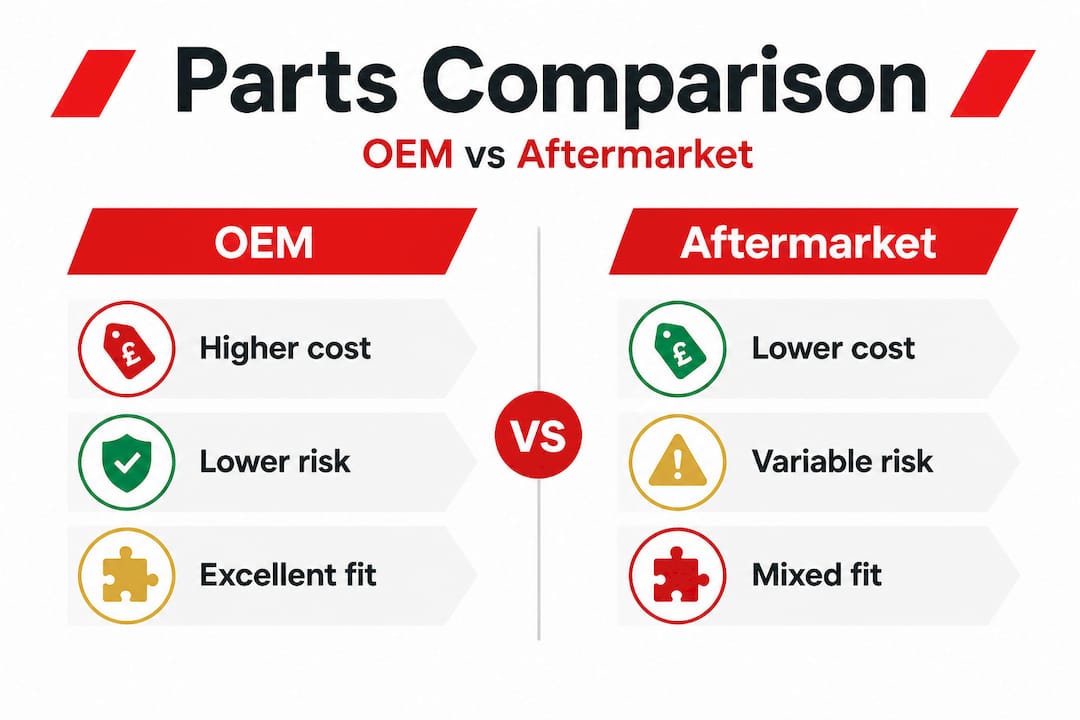
Understanding the difference between OEM and aftermarket helps you avoid the trap of choosing purely on price. UK repair shops that prioritise customer retention consistently lean towards OEM or verified high-grade aftermarket for anything screen or battery related.
Pro Tip: If you do use aftermarket parts, always ask suppliers for grade specifications. “Grade A” means different things to different distributors, so request a datasheet or performance certificate for any batch you’re sourcing in volume.
It is also worth understanding OEM quality in detail before committing to a supplier, particularly if you’re ordering at scale. The tolerances on connectors, adhesive bonds, and panel coatings can differ considerably even within the aftermarket category.
“The cheapest part rarely produces the cheapest outcome. In mobile repair, the real cost of a low-grade component is almost always paid on the second visit.”
Essential checklist: What to evaluate before buying
Once you understand your options, it’s time to apply a clear checklist before ordering any replacement. Buying a part without going through this process is one of the most common reasons repairs fail or require costly rework.
Shops should check compatibility, source reputation, and warranty terms for each part ordered. These three factors alone filter out the majority of problematic purchases before they reach your workbench.
Evaluation framework
| Factor | What to check | Why it matters |
|---|---|---|
| Device compatibility | Exact model number, not just brand | Wrong connectors cause damage on fitting |
| Supplier credentials | Trading history, reviews, returns policy | Protects against fakes and poor service |
| Part grade | OEM, Grade A, B, refurbished | Sets performance expectations accurately |
| Warranty coverage | Duration and what it includes | Safety net for early failures |
| Packaging and documentation | Serial numbers, certification marks | Indicates authenticity and traceability |
| Returns policy | Days allowed, condition required | Critical if the part arrives faulty |
Follow this numbered process before confirming any order:
- Confirm the exact model number of the device you’re repairing. For iPhones, check the model identifier (e.g. A2411), not just “iPhone 12”. For Samsung Galaxy devices, regional variants can have different connector placements.
- Research the supplier. Look for UK-based companies with verifiable reviews on Trustpilot or Google. Check whether they have a physical address and a genuine returns process.
- Check the part grade and specification. Ask explicitly whether the part is OEM, OEM-quality, or aftermarket, and what grade applies. A vague answer is a red flag.
- Review the warranty terms. A credible supplier will offer at least 30 days on parts. Read what the warranty covers, specifically whether it includes fitting faults or just manufacturing defects.
- Assess the return window and process. You should be able to return a faulty part without unreasonable conditions. Suppliers who make returns difficult are warning you indirectly. Review replacement part warranty tips to understand what terms are reasonable and which are not.
- Order a single unit first if batch buying. Test performance and fit before committing to stock.
Guidance on identifying genuine parts before purchase can save considerable time and money, particularly when ordering screens or batteries at volume.
Pro Tip: Never skip checking the supplier’s return policy. A part that arrives damaged, misaligned, or dead on arrival is not unusual in the supply chain. If you can’t return it easily, that cost falls directly on your margin or your customer relationship.
How to spot genuine and high-quality parts
Even with the right checklist, many buyers are caught out by convincing fakes. The mobile parts market in the UK includes a significant volume of counterfeit and misrepresented stock, particularly for high-demand components like iPhone screens and Samsung batteries. UK shops emphasise the need for thorough visual and supplier checks to avoid fakes reaching the customer’s device.
Red flags to watch for
- No part number, serial number, or batch code on the component itself
- Packaging that appears generic, unbranded, or poorly printed
- Supplier unwilling to provide documentation or grade confirmation
- Prices significantly below the market rate for the component type
- No returns policy or an unusually short warranty period
- Connector quality feels loose, rough, or visually different from original
Trusted indicators of a quality part
- Clear manufacturer or supplier branding on packaging
- Matching model compatibility printed on the box or accompanying document
- Batch or serial number that corresponds to supplier records
- Secure connector fit during initial inspection
- Supplier offers a warranty that includes early performance failure
Once goods arrive, follow these verification steps:
- Inspect the outer packaging for print quality, branding consistency, and labelling. Counterfeits often have blurry text or inconsistent fonts.
- Check the connector and ribbon cable before fitting. It should align cleanly with the original and show no signs of oxidation or bending.
- Compare the part visually against the original. Weight, panel thickness, and cable routing should all be consistent.
- Power test before full installation where possible. For screens, use a test board or a partial reassembly to check display and touch function before applying adhesive.
- Document your findings. For shops, photographing parts before fitting protects you if a customer later disputes a fault.
“Fitting a counterfeit part to a customer’s phone is never worth the short-term saving. When it fails, and it often does, you absorb the cost of the rework and the reputational damage.”
The genuine parts guide at Buy2fix covers device-specific visual markers and supplier indicators that give you a practical reference when evaluating stock.
Popular replacements and typical pitfalls
With a solid check process in place, awareness of the most problematic parts and pitfalls can further reduce costly errors. Customer complaints and repair failures are often traced to poor part choice, and the same components appear repeatedly in post-repair disputes.
Most commonly replaced parts in UK repair shops
- Screens and display assemblies (iPhone, Samsung, Huawei, Xiaomi)
- Batteries (especially for ageing flagships seeking a second life)
- Charging ports and flex cables
- Rear camera modules
- Back glass panels and housings
- Speaker and microphone modules
- Power and volume button assemblies
Each of these carries its own specific pitfalls. Screens are the most complex because performance varies so much between grades. A low-grade LCD replacement on a phone that originally shipped with OLED will produce visibly inferior results, leading to immediate dissatisfaction even if the part technically functions. Batteries present a different problem: capacity misrepresentation. A battery labelled at 3,000mAh may deliver considerably less, something only testable with proper diagnostic tools.
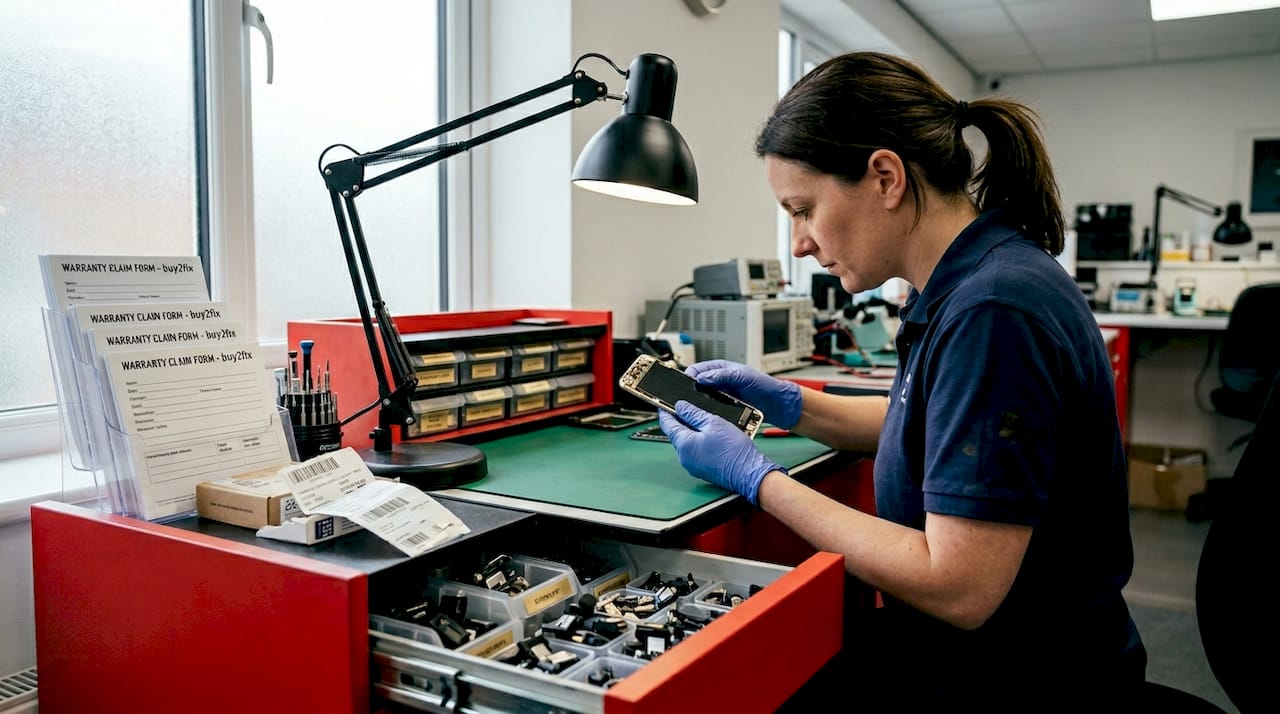
Charging ports are frequently ordered without confirming the exact variant. Many Samsung Galaxy models have multiple charging port versions across production batches, and fitting the wrong one creates connection faults that are difficult to diagnose afterwards.
For guidance on frequently needed components, the common mobile part replacements guide provides device-specific information for the parts most likely to cross your workbench.
Pro Tip: For repair shops placing batch orders, never order six months of stock from a new supplier without a trial period. Supply chain changes, manufacturing shortcuts, and inconsistent quality control mean that a batch from March can perform very differently to one from September. Order monthly until you have confidence in consistent quality.
Hobbyists face a slightly different risk. The temptation to buy the cheapest screen on a marketplace without researching the seller leads to mismatched parts, missing adhesive strips, or components clearly graded below what the listing claimed. Budget for slightly more than the absolute minimum and choose a supplier with a genuine UK return process.
Why quality outweighs quick savings: Our take
Most advice in the repair parts market overemphasises cost savings. “Save money on parts” is easy guidance to give. It is also the guidance most likely to send a customer back through your door unhappy three weeks later.
Our experience working with repair shops across the UK tells a consistent story. The shops with the strongest customer retention are not the ones offering the lowest prices. They are the ones who have made a deliberate decision to source reliably, even when it means a tighter margin. UK repair shops report that customer retention is higher when prioritising OEM and verified high-quality parts over lowest-cost aftermarket. A comeback repair costs you labour, goodwill, and often a replacement part too. That is never cheaper than doing it right the first time.
There is also an uncomfortable truth about the aftermarket parts market that rarely gets stated clearly. The phrase “high-quality aftermarket” covers an enormous spectrum. At the top end, it genuinely approaches OEM performance. At the bottom end, it is barely functional stock that exists because buyers keep purchasing on price alone. Every time a repair shop buys the cheapest possible screen, it sustains the market for parts that were never fit for purpose.
For DIYers, the calculation is slightly different but the principle holds. If you are spending an afternoon replacing your own battery or screen, the worst outcome is not wasting money on a bad part. It is discovering that the part failed after you have already reassembled the device, which means disassembling it again and risking damage to connectors or adhesive bonds that were only meant to be disturbed once.
Pro Tip: If you run a repair business, track your comeback repairs by part type and supplier. After three months, the data will tell you exactly where your losses are coming from. Most shops find that a small number of low-cost suppliers account for the majority of rework. Switching those out pays for itself quickly. Review replacement part warranty policies as part of this audit too, since warranty coverage directly affects how much rework actually costs you.
Quality is not a premium feature. For both DIYers and repair businesses, it is the baseline that makes every other part of the process worthwhile.
Find reliable mobile replacement parts with ease
If you’re ready to take the guesswork out of sourcing, Buy2fix makes it straightforward. We stock verified replacement parts for iPhone, Samsung Galaxy, Huawei, Xiaomi, OPPO, and more, all quality checked before dispatch. Every order to UK mainland addresses comes with free shipping, and our 30-day return policy means you are protected if something does not meet expectations. Whether you are a professional technician ordering in volume or a first-time DIYer replacing a cracked screen, you will find clear part specifications, honest grading, and real customer support on the trusted Buy2fix platform. We understand what repair buyers actually need, and we have built our inventory and policies around that.
Frequently asked questions
What is the safest way to identify a genuine mobile part?
Check supplier reputation, look for manufacturer markings, and request authenticity documentation to ensure a part is not counterfeit. Reputable suppliers will always provide warranty terms and traceability details without hesitation.
Are aftermarket parts reliable for most smartphone repairs?
Aftermarket parts vary considerably in quality and may save money upfront, but quality gaps between OEM and aftermarket are significant enough to risk repeat failures if you choose purely on price. Only use aftermarket from verified, graded suppliers.
Should small repair shops always use OEM parts?
OEM parts offer the best chance of customer satisfaction and lowest comeback rate, but where budget or availability requires it, high-grade aftermarket is a reasonable alternative. Customer retention is higher with OEM, so treat it as the default where margins allow.
What warranty should I expect with replacement parts?
Most reputable suppliers offer a 30 to 90 day warranty covering manufacturing defects and early failures. Always confirm warranty terms before purchasing, and avoid suppliers who offer no warranty at all or attach unreasonable conditions to claims.
Recommended
Let customers speak for us
For Samsung Galaxy A26 SM-A266B Original Earpiece Speaker with Cable

Very good communication throught. Good product

Well made part very strong easy to fit great value for the money

Well packed, with fast shipping :)

Exactly what the doctor ordered…great color, comfort, and durability. Trust this watch band!

Brilliant strap, second purchase, bought bracelet before. Excellent value. Thank you

Great item for splitting your Audio signal

Outstanding product!
Next level customer service.

Very satisfied but the delivery needs to get more faster...

Good price,quick delivery

Best phone case ever! This is my second one as I broke my first. Would defo recommend

Great fitting Apple Watch bands

For Apple Watch Ultra 3 / 2 / 1 49mm RedPepper Armor Metal Case Integrated Silicone Watch Band(Steel Black White)

Good price and quick postage

