

Advantages of OEM phone parts for reliable repairs
TL;DR:
- OEM phone parts are manufactured to the original equipment maker’s exact specifications, ensuring perfect fit, functionality, and safety. Using genuine parts preserves device features, warranty coverage, and long-term durability, reducing rework and safety risks associated with aftermarket components. While more expensive upfront, OEM parts lower long-term repair costs and maintain device performance, making them the best choice for active daily-use devices.
OEM phone parts are components manufactured to the exact specifications set by the original equipment maker, delivering consistent quality and optimal device performance from the first installation. Whether you are repairing your own iPhone, Samsung Galaxy, or Huawei device, or running a professional repair workshop, the choice between genuine and aftermarket parts shapes every outcome that follows. Aftermarket components flood the market at lower prices, but the advantages of OEM phone parts extend well beyond the initial transaction. Fit, functionality, warranty continuity, and long-term safety all depend on what goes inside the device.
1. Advantages of OEM phone parts: exact fit and model-specific compatibility
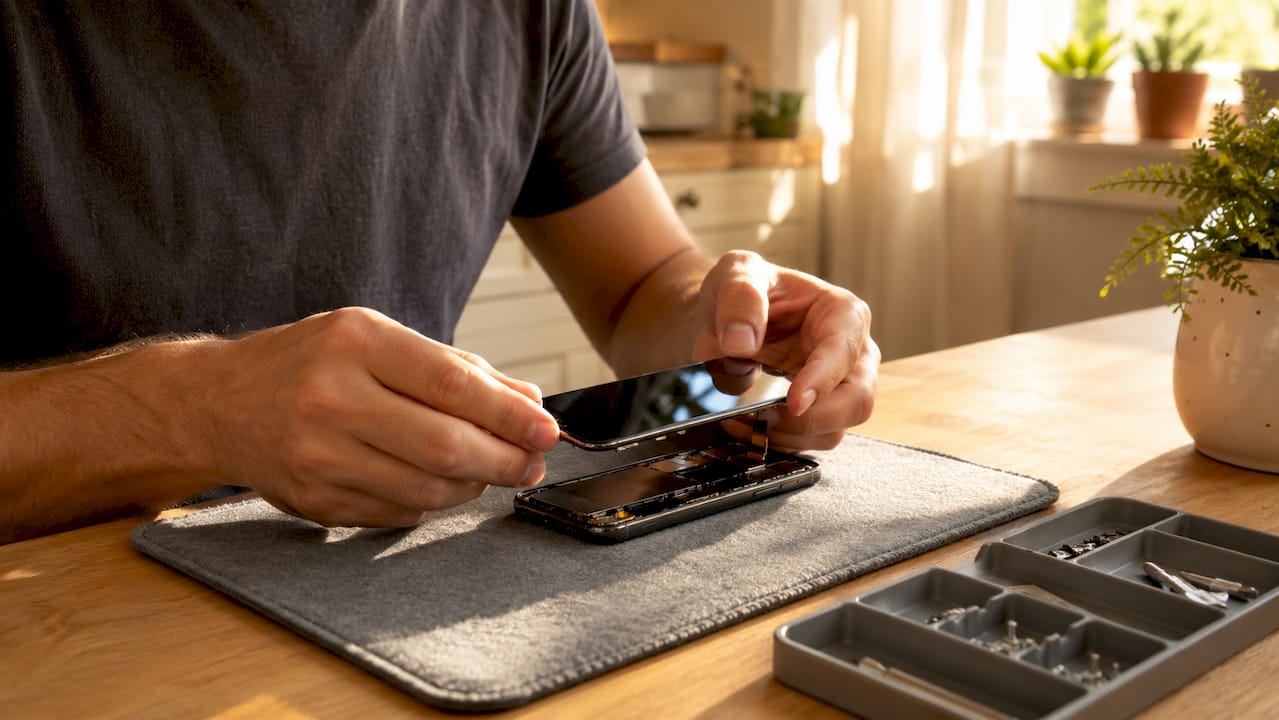
The single most underappreciated benefit of genuine parts is dimensional precision. OEM components are engineered to the same manufacturing tolerances as the original assembly line, which means screens seat flush, batteries connect without adapter cables, and housing panels align without gaps. That precision is not cosmetic. A screen that sits even fractionally proud of the chassis creates pressure points that crack the glass under normal use.
Aftermarket parts introduce fit-related failure risks that are difficult to diagnose after the fact. Inconsistent fit can lead to water and dust ingress, which voids waterproofing ratings on devices like the Samsung Galaxy S24 or iPhone 15. Structural components including batteries, charging ports, and rear housings are especially sensitive to dimensional variation.
- Verify the exact model number before ordering. An iPhone 14 screen is not interchangeable with an iPhone 14 Pro despite similar dimensions.
- Cross-reference part numbers against the manufacturer’s service documentation or a trusted supplier like Buy2fix.
- Check that OLED panels carry the correct flex cable connector type for your specific board revision.
Pro Tip: Always photograph the original part number printed on the component before removal. That reference eliminates compatibility guesswork entirely.
2. How OEM parts preserve manufacturer warranty and device features
Using genuine parts is the clearest path to keeping your manufacturer warranty intact. Apple, Samsung, and Huawei all specify that repairs carried out with non-genuine components can void coverage, leaving you exposed to full replacement costs on a device that may still be under guarantee.
The stakes go beyond paperwork. Genuine parts preserve full functionality for Face ID, True Tone display calibration, and biometric security sensors. These features rely on software-level pairing between the component and the device’s secure enclave. Fit an aftermarket screen on a recent iPhone and you will likely see a persistent warning in Settings, with True Tone and automatic brightness disabled permanently. That is not a minor inconvenience. It degrades the daily experience and signals to any future buyer that the device has been repaired with non-genuine parts.
Resale value and trade-in acceptance are directly affected. Devices repaired with original components retain manufacturer warranty and command higher trade-in prices. A phone flagged as having a non-genuine display can lose a significant portion of its assessed value at trade-in, which erodes the apparent savings from cheaper parts.
3. Why OEM parts deliver superior durability and performance
Longevity is where the financial case for genuine parts becomes clearest. Genuine batteries last two to three years under normal use, compared to roughly six months for cheap aftermarket alternatives. That gap means a device repaired with a counterfeit battery may need a second battery replacement before a device repaired with a genuine one needs its first.
OEM screens tell a similar story. Genuine screens last 12 to 24 months longer than aftermarket versions, and OEM parts experience fewer than 5% calibration failures or firmware lockouts. That figure matters enormously for technicians managing volume repairs, where a 5% failure rate across 200 jobs per month means ten callbacks.
| Performance factor | OEM parts | Aftermarket parts |
|---|---|---|
| Battery lifespan | 2 to 3 years | Approximately 6 months |
| Screen longevity | 12 to 24 months longer | Degrades faster |
| Calibration failure rate | Under 5% | Significantly higher |
| Waterproofing retention | Maintained with correct installation | Rarely preserved |
| Thermal expansion match | Consistent with OLED adhesion spec | Often mismatched |
Non-genuine components often lack original design specifications, leading to safety risks including battery swelling and, in documented cases, fire hazards. That is not a theoretical concern. Counterfeit lithium-ion cells bypass the protection circuits that prevent overcharging, and the consequences range from a ruined device to a genuine safety incident.
Pro Tip: When sourcing batteries, check that the cell carries the correct milliamp-hour rating and that the protection board matches the original. A battery that fits the connector but lacks the correct protection circuit is more dangerous than no battery at all.
4. How OEM parts improve repair reliability and technician efficiency
For professional technicians, OEM parts reduce rework rates and require verification of model-specific compatibility to prevent repair failures. That reduction in rework is not just about pride of craft. Every callback costs labour time, replacement parts, and customer goodwill.
Laboratory and field tests show that OEM parts significantly reduce technician rework time, improving operational efficiency under high-volume repair conditions. A workshop processing 50 repairs per week that cuts its callback rate from 15% to under 5% by switching to genuine parts saves roughly five jobs worth of labour time each week. At typical UK repair labour rates, that compounds quickly.
- Predictable fit reduces bench time per job, since technicians do not need to adapt or force components.
- Batch-level quality controls on OEM parts mean fewer dead-on-arrival components discovered mid-repair.
- OEM display flex cables show consistent solder joints and gold plating, indicating controlled manufacturing and better reliability across the batch.
- Calibration steps after installation are faster because the component behaves predictably within the device’s firmware.
The efficiency argument is particularly strong for biometric and power management components. Aftermarket parts may function acceptably for older or secondary devices, but OEM parts are strongly recommended for biometric sensors, power management, and structural components to prevent cascading failures. A faulty power management IC fitted to save £15 can stress the main board and turn a £60 repair into a write-off.
5. OEM parts versus aftermarket: what factors should influence your choice?
The OEM versus aftermarket decision is not always binary, but the factors that should tip it are clear.
| Factor | OEM parts | Aftermarket parts |
|---|---|---|
| Quality consistency | High, batch-controlled | Variable, supplier-dependent |
| Upfront cost | Higher (screens £200 to £400) | Lower (screens £80 to £150) |
| Long-term cost | Lower due to fewer repeat repairs | Higher due to failure rates |
| Warranty impact | Preserved | Often voided |
| Feature compatibility | Full (Face ID, True Tone, biometrics) | Partial or none |
| Safety | Meets original safety specifications | Risk of substandard cells |
Repeat repairs are up to 30% more common with low-quality aftermarket parts, increasing long-term costs despite upfront savings. Aftermarket parts are typically 20 to 40% cheaper at the point of purchase, but that saving erodes quickly when a second repair is needed within months.
Aftermarket parts can serve as a reasonable solution for older devices outside warranty, where the cost of a genuine part exceeds the device’s market value. A five-year-old mid-range Android phone with a cracked screen may not justify a genuine OEM panel. In that scenario, a reputable aftermarket screen from a known supplier is a pragmatic choice.
The greatest risk with non-genuine parts is escalation damage, where a faulty component stresses other internal parts, potentially resulting in total device failure instead of a simple repair. That risk alone justifies OEM parts for any device still in active daily use.
Pro Tip: When vetting a supplier, ask for batch test reports or quality certifications. A legitimate OEM parts distributor can provide documentation. If a supplier cannot, treat that as a red flag regardless of price.
6. The safety case for genuine parts that most buyers overlook
Safety is the argument that rarely appears in price comparisons but carries the most weight. Counterfeit batteries degrade rapidly and pose documented safety risks. The protection circuits in genuine batteries prevent overcharge, over-discharge, and short-circuit events. Counterfeit cells frequently omit or downgrade these circuits to reduce manufacturing cost.
OEM parts maintain device waterproofing when installed correctly, preserving structural integrity that many aftermarket parts cannot replicate. For devices rated IP67 or IP68, a non-genuine screen without the correct adhesive gasket profile eliminates that protection entirely. The user has no visible indication that their water resistance is gone until the device meets a puddle.
Choosing OEM parts also ensures consistent thermal expansion properties required for stable OLED panel adhesion over the device lifespan. A mismatch in thermal expansion between the panel and the chassis causes delamination over time, producing the lifting edges and dead zones that look like physical damage but originate from a chemistry mismatch in the replacement part.
7. Identifying genuine OEM parts and avoiding misleading labels
The term “OEM” is used loosely in the parts market, and that ambiguity costs buyers money and devices. Technicians distinguish between factory-branded parts and verified OEM parts, both of which still require model-specific validation before installation. A part labelled “OEM quality” or “OEM grade” is almost certainly an aftermarket component using the term as a marketing description rather than a manufacturing claim.
Genuine OEM parts carry the original manufacturer’s part number, arrive in manufacturer or authorised distributor packaging, and come with traceable batch documentation. Aftermarket screens often miss protective coatings and structural refinements, leading to ghost touches and rapid degradation. Those symptoms are the clearest field indicator that a screen is not genuine, regardless of what the packaging claimed.
For guidance on identifying authentic parts before purchase, cross-referencing part numbers against manufacturer service documentation is the most reliable method available to both DIY buyers and professional technicians.
Key takeaways
OEM phone parts deliver lower long-term costs, safer repairs, and better device performance than aftermarket alternatives, making them the correct choice for any device in active daily use.
| Point | Details |
|---|---|
| Fit and compatibility | OEM parts match exact factory tolerances, preventing ingress, misalignment, and firmware conflicts. |
| Warranty and features | Genuine parts preserve Face ID, True Tone, biometrics, and manufacturer warranty coverage. |
| Durability advantage | Genuine batteries last 2 to 3 years versus 6 months for cheap aftermarket cells. |
| Technician efficiency | OEM parts reduce rework rates and callback frequency, lowering operational costs over time. |
| Safety and waterproofing | Genuine components meet original safety specifications and maintain IP-rated waterproofing when correctly installed. |
Why I always reach for genuine parts first
After years of handling repair queries and sourcing parts for both DIY customers and professional workshops, the pattern I see most consistently is this: the jobs that come back are almost always the ones where cost drove the parts decision rather than quality.
The counterintuitive truth is that OEM parts are often the cheaper option when you account for the full repair lifecycle. A genuine Samsung Galaxy screen costs more on the invoice, but it does not come back in three months with ghost touches or a dead zone in the corner. An aftermarket screen that fails at month four costs the technician a replacement part, labour time, and a customer who tells their contacts not to use that workshop.
I am not dismissive of aftermarket parts across the board. For a device outside warranty, past its useful life, or being repaired as a temporary measure, a reputable aftermarket component from a known supplier is a legitimate call. The mistake is applying that logic to a current-generation device with biometric sensors, OLED calibration, and an active warranty. Those devices deserve genuine parts, and the user deserves to know the difference before the repair begins.
The label “OEM quality” on a parts listing is a marketing phrase, not a specification. If you cannot get a batch number and a verifiable part reference, you are buying on trust alone. That is a risk worth understanding clearly before the screwdriver goes in.
— Adewale
Source your OEM parts from Buy2fix with confidence
Buy2fix stocks replacement parts for iPhone, Samsung Galaxy, Huawei, Xiaomi, and OPPO devices, with quality checks carried out before dispatch. Every order to UK mainland addresses ships free, and eligible items carry warranty support so you are covered if a part does not perform as expected. Whether you are a DIY buyer replacing a cracked screen or a professional technician sourcing components in volume, Buy2fix provides clear product information and fair pricing without the guesswork. Browse the full range of genuine repair parts and find the component your device needs, backed by a 30-day return policy and a team that understands what reliable repairs actually require.
FAQ
What are OEM phone parts?
OEM phone parts are components manufactured to the original equipment maker’s exact specifications, either by the manufacturer directly or by an authorised supplier. They deliver the same fit, function, and quality as the parts used during original device assembly.
Are OEM parts worth the higher upfront cost?
Repeat repairs are up to 30% more common with low-quality aftermarket parts, which means the lower purchase price rarely holds over the device’s lifetime. For any device in active daily use, genuine parts cost less across the full repair lifecycle.
Do OEM parts preserve Face ID and True Tone on iPhones?
Genuine Apple parts preserve full functionality for Face ID, True Tone, and biometric security. Aftermarket screens typically disable these features permanently through software-level pairing restrictions built into the device’s secure enclave.
How do I tell if a part is genuinely OEM?
Genuine OEM parts carry the original manufacturer’s part number, arrive in traceable packaging, and come with batch documentation. Labels reading “OEM quality” or “OEM grade” are marketing terms for aftermarket components and do not indicate genuine manufacture.
Can aftermarket parts damage other components?
A faulty non-genuine component can stress surrounding internal parts, turning a straightforward repair into total device failure. This escalation risk is highest with power management components, batteries, and biometric sensors.
Recommended
Let customers speak for us
For Samsung Galaxy A26 SM-A266B Original Earpiece Speaker with Cable

Very good communication throught. Good product

Well made part very strong easy to fit great value for the money

Well packed, with fast shipping :)

Exactly what the doctor ordered…great color, comfort, and durability. Trust this watch band!

Brilliant strap, second purchase, bought bracelet before. Excellent value. Thank you

Great item for splitting your Audio signal

Outstanding product!
Next level customer service.

Very satisfied but the delivery needs to get more faster...

Good price,quick delivery

Best phone case ever! This is my second one as I broke my first. Would defo recommend

Great fitting Apple Watch bands

For Apple Watch Ultra 3 / 2 / 1 49mm RedPepper Armor Metal Case Integrated Silicone Watch Band(Steel Black White)

Good price and quick postage

